
On-site Oil Purification, Vacuum Dehydration & High-Velocity Oil Flushing · Rio Grande Valley, Texas
Give your oila second life.
On-site oil and fuel treatment for industrial facilities in Texas.
We filter, dehydrate, and reclaim hydraulic and lubricating oils, flush oil systems, and clean diesel fuel at your facility, so you replace less oil and keep equipment running.
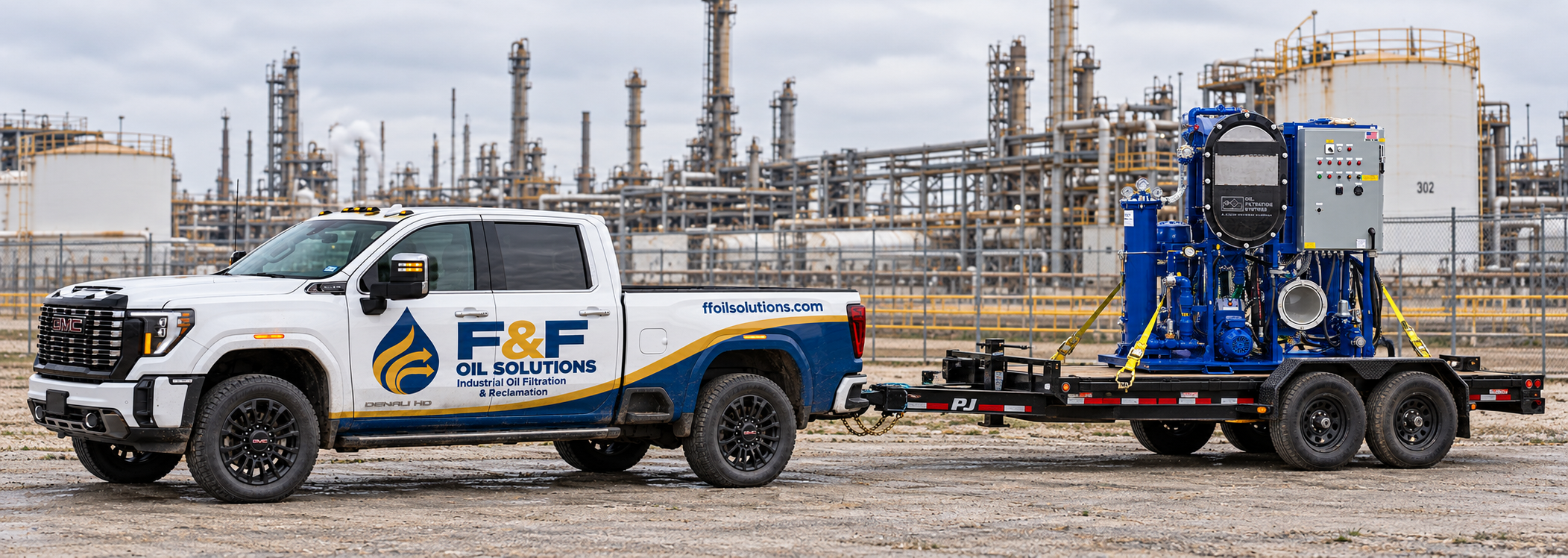 F&F Oil Solutions mobile oil filtration and dehydration unit
On-site serviceWe bring the equipment to your plant.
Oil & fuelHydraulic, lube, turbine oils and diesel.
Measured resultsISO 4406 particle counts and water content.
English & EspañolRio Grande Valley, Texas.
Our equipment
Our truck. Our unit. At your facility.
Our service truck tows the treatment unit to your plant and connects to your system on site, so your oil never has to leave the facility.
What we do
Six ways we help. One goal: cleaner oil and fuel.

Oil Purification
SolvesWater and particles are wearing out your oil.
ForHydraulic, lube, turbine and compressor systems.
See details
High-Velocity Flushing
SolvesDirty piping after an install, repair or failure.
ForNew systems, overhauls and contamination events.
See details
Fuel Filtration
SolvesWater and dirt in stored diesel plug filters and injectors.
ForGenerators, fuel tanks and equipment fleets.
See details
Hydraulic Leak Repair
SolvesConstant top-offs, oil on the floor and lost fluid.
ForPresses, power units and hydraulic machinery.
See details
Oil Sampling & Analysis
SolvesNot knowing whether to treat or replace the oil.
ForAny plant making oil decisions with data.
See details
Ongoing Oil Care
SolvesThe same contamination problems coming back.
ForFacilities that want oil care on a schedule.
See detailsResults you can see
See the difference. Verify the condition.
Before-and-after samples can show visible changes following treatment. Oil analysis helps determine what those changes mean for your equipment.
Particle & metal contamination
Actual samples from the same treatment project. Visual appearance is provided for reference; laboratory results are needed to assess cleanliness, water content, and other oil properties. Results vary by oil condition and application.
Where available, project results may include
- Equipment and oil type.
- Volume treated.
- Initial contamination concerns.
- Service performed.
- Particle count or ISO cleanliness results before and after.
- Water content before and after.
- Recommended next steps.
Ready when you are
Find out if your oil can be saved.
Tell us about your equipment and oil. We reply with next steps and a quote.
Our Process
A clear approach, from evaluation to follow-up.
- 1
Understand your operation.
We review your equipment, oil types, reservoir volumes, maintenance practices, and current concerns.
- 2
Assess oil condition.
We define the sampling and testing needed to evaluate contamination and treatment suitability.
- 3
Recommend the service.
We propose an appropriate scope, equipment arrangement, schedule, and service objectives.
- 4
Perform the work.
We coordinate with your team on access, connections, operating conditions, and any required shutdown.
- 5
Review the results.
We review observations and any agreed post-service testing against the project objectives.
- 6
Plan the next step.
We recommend follow-up sampling or maintenance based on the findings.
How treatment works
Contaminated in. Conditioned out.
Particles
Water
Conditioned oil
Contaminated in
Conditioned out
From contaminated to conditioned
What treatment does to the oil.
Scroll to follow a sample through assessment, filtration, dehydration and verification.
- 01AssessOil type, viscosity grade, equipment, volume and the contamination you're seeing.
- 02FilterSuspended particles are captured to move the fluid toward the cleanliness level required.
- 03DehydrateFree and emulsified water is reduced with a method matched to the oil and the equipment.
- 04VerifyResults are documented and follow-up lab analysis is recommended when it applies.
21/19/16
900ppm
Sample received
Illustrative example only. Actual results depend on oil condition, contamination type and operating conditions, and are confirmed by analysis.
Savings & value
15–30%
Potential savings
Potential savings vary depending on oil condition, replacement cost, treatment requirements, equipment needs and operating conditions. Savings are not guaranteed and should be confirmed through a customer-specific evaluation.
An assessment helps you compare:
Replacing the oilNew fluid for the full system volume.
Analyzing and treating itLab tests plus filtration or dehydration.
Transport and disposalHauling and disposing of used oil.
DowntimeTime the machine is stopped, or the intervention required.
Service details
Oil care for your oil and the systems that use it.
Core service
Oil Purification, Filtration & Vacuum Dehydration
The core of F&F Oil Solutions.
Our core service is on-site oil purification. It combines particle filtration and vacuum dehydration to treat suitable hydraulic, lubricating, turbine, and compressor oils at your facility, and to reclaim oil that can stay in service.
Filtration targets solid contamination. Vacuum dehydration targets free and dissolved water and helps release entrained air and gases. Together, these processes can help recover usable oil and support cleaner operating conditions.
Treatment suitability depends on the oil type, condition, contamination, and equipment requirements. Reclamation does not reverse every form of oil degradation or restore depleted additives.
Applications we evaluate
- Hydraulic power units and reservoirs.
- Hydraulic presses and stamping equipment.
- Plastic injection molding and die casting equipment.
- Compatible industrial lubrication systems.
- Turbine and compressor lube oil systems, reviewed individually.
- Other oil-filled industrial systems reviewed individually.
Benefits
- Help extend the useful life of suitable oil.
- Reduce water and particle contamination.
- Support equipment reliability.
- Help reduce avoidable oil replacement and disposal.
- Support maintenance decisions with oil condition information.
Where the equipment design and site conditions allow, treatment may be performed while the machine remains in operation. We assess connection requirements and operating conditions before confirming the service approach.
High-Velocity Oil Flushing
Clean the circuit. Support the next start-up.
High-velocity oil flushing circulates a compatible fluid through an agreed system or circuit at flow rates above normal operating flow. The turbulent flow helps lift particles and residual contamination from piping and components so our filtration equipment can capture them.
Projects may include new installations and pre-commissioning, maintenance work, component replacement, or contamination recovery. Flow requirements, fluid compatibility, circuit configuration, and cleanliness targets, such as an ISO 4406 code, are reviewed before the service is defined.
Potential applications
- Hydraulic piping and circuits.
- Lubrication piping and systems.
- Turbine and compressor lube oil systems.
- New system start-up and pre-commissioning.
- Selected industrial oil circuits.
- Suitable systems at manufacturing, energy, and oil and gas facilities.
Each proposal defines the circuits to be flushed, flushing fluid, fluid supply responsibility, connection points, operating requirements, and acceptance criteria.
New
Fuel Filtration & Water Removal
Clean, dry fuel for the engines you depend on.
Water and particles in stored diesel can plug filters, wear fuel injectors, and lead to unplanned stops. We filter fuel in tanks and supply systems with high-efficiency filter elements combined with coalescer and separator elements that remove free water.
Service can be scheduled for storage tanks, day tanks, standby generator fuel, and equipment fleets. Fuel sampling can be included to compare condition before and after treatment.
Potential applications
- Diesel for standby and prime power generators.
- Fuel storage tanks and day tanks.
- Fuel supply for turbines and large diesel engines.
- Heavy equipment and fleet fuel.
- Light fuel oils and other fuels, reviewed individually.
Fuel type, tank access, and site safety requirements are reviewed before service. Heavily degraded fuel or fuel with microbial growth may also need tank cleaning or other treatment.

Hydraulic Leak Inspection & Repair
Find the leak. Reduce the loss.
We inspect hydraulic systems to identify visible leaks and assess repair needs at hoses, fittings, connections, seals, and accessible components.
After inspection, we define the repair scope, required parts, and service schedule with your maintenance team. Repairs depend on component condition, accessibility, and parts availability.
Benefits
- Help reduce oil loss and repeated top-offs.
- Address sources of recurring leaks.
- Support cleaner work areas.
- Improve visibility into hydraulic maintenance needs.
Equipment must be safely isolated and depressurized as required for inspection or repair.
Oil Sampling & Analysis
Understand your oil before deciding what comes next.
Oil sampling helps identify contamination and evaluate whether the oil is suitable for continued use, treatment, or replacement.
Depending on the application, assessment may include visual inspection, patch testing, and laboratory analysis.
Available laboratory testing can include
- Particle count and ISO 4406 cleanliness reporting.
- Water content by Karl Fischer.
- Viscosity at 40°C.
- Acid number (TAN).
- FTIR analysis.
- ICP elemental analysis for wear metals and selected contaminants.
The testing scope is selected for the oil, equipment, and maintenance objective. Visual appearance alone does not confirm oil condition.
Ongoing Oil Care Programs
Make oil condition part of your maintenance routine.
We can develop a service schedule around your equipment, operating hours, contamination exposure, and oil analysis results.
Programs may include scheduled sampling, oil condition reviews, filtration or dehydration when indicated, and follow-up on leak repair needs.
Service frequency is defined for your facility and adjusted as conditions change.

Inside our systems
Industrial-grade equipment. Built to remove what damages your oil and fuel.
Every service runs on purpose-built equipment. Here is what each system does and why it matters for your operation.
01 · Vacuum dehydration
Removes water in every form.
Under vacuum, water evaporates at a much lower temperature, so it can be removed without overheating the oil. The process targets free, emulsified, and dissolved water, and it also pulls out entrained air and gases.
- Helps the oil keep its viscosity and lubricating film.
- Helps reduce rust, corrosion, and oxidation caused by water.
- Suitable for turbine, hydraulic, compressor, gear, and other compatible oils.
- Can run continuously while the equipment operates, where the setup allows.
02 · High-efficiency filtration
Captures particles you can’t see.
We use pleated microglass filter elements rated Beta(c) ≥ 1000 per ISO 16889, which means 99.9% capture at the rated micron size. Micron ratings range from 2.5 to 22, and bag pre-filters can be added for heavily contaminated fluid to protect the finer elements.
- Progress is measured with ISO 4406 cleanliness codes.
- Helps reduce wear on pumps, valves, bearings, and servo valves.
- Element size is selected for each fluid and cleanliness target.
03 · High-flow flushing skids
Turbulent flow, adjusted to each circuit.
Our flushing skids pair high-flow pumps with variable frequency drives, so flow can be set for each circuit. Depending on the unit, options include an oil heater, inline particle monitoring with an ISO-format readout, and a reverse-flow manifold.
- Flow set to create turbulent conditions in piping.
- Extra particle removal for tanks, sumps, and reservoirs.
- Particle protection for dehydrators and critical equipment.
- Transfer pumping with filtration when oil is moved.
04 · Fuel filter & coalescer
Clean, dry fuel.
Fuel first passes through high-efficiency elements that capture particles. Coalescer elements then merge fine water droplets, separator elements keep them out of the clean fuel, and the water settles to the bottom of the vessel to be drained.
- Helps protect fuel injectors on generators and diesel engines.
- Helps prevent premature plugging of filters in the field.
- Helps fuel meet the cleanliness levels engine and turbine makers specify.
Did you know?
New oil isn’t always clean oil.
New oil can arrive with more particles than your equipment manufacturer recommends. Filtering it as it goes into the system helps your equipment start clean.
Equipment specifications and options vary by unit. We confirm the right setup for your application during the assessment.
Industries
Oil care for the equipment your operation depends on.
Our services focus on hydraulic and lubrication systems across industrial applications. We assess the specific equipment, fluid, and service requirements before recommending a solution.
Manufacturing & Metalworking
Hydraulic presses, stamping lines, press brakes, power units, and compatible lubrication systems.
Plastics, Injection Molding & Recycling
Hydraulic molding machines, recycling equipment, balers, and other compatible hydraulic systems.
Die Casting & Foundries
Hydraulic circuits and power units operating in demanding production environments.
Oil & Gas
Hydraulic power units, support equipment, and suitable lubrication systems at oilfield and processing facilities. Flushing scope is evaluated for each application.
Refineries & Petrochemical Facilities
Selected hydraulic and lubrication systems, with service planning based on fluid compatibility, site requirements, and the agreed scope.
Concrete, Cement & Aggregates
Hydraulic systems on batching equipment, crushers, material handling equipment, and other suitable machinery.
Heavy Equipment & Industrial Support
Selected hydraulic and lubrication systems used in construction, logistics, and industrial service operations.
Your equipment
Not sure if your system fits? Tell us what you run and we will review it.
Tell Us About Your EquipmentWhy F&F Oil Solutions?
Practical oil care. Focused on your operation.
On-site service planned around your equipment and facility.
Filtration and dehydration as our core service.
Additional support for flushing, fuel filtration, and hydraulic leaks.
Recommendations guided by oil condition and application requirements.
Clear service scopes and communication.
A focus on reducing avoidable oil waste and supporting equipment reliability.
About us
Helping industrial operations get more value from their oil.
F&F Oil Solutions is a Texas-based business founded by two brothers with a shared goal: helping industrial facilities manage oil contamination, reduce avoidable waste, and care for the equipment their operations depend on.
Our foundation is on-site oil filtration, vacuum dehydration, and reclamation. We also offer oil flushing, oil sampling and analysis, and hydraulic leak inspection and repair.
We work with maintenance and engineering teams to understand each application and recommend a service scope that fits the equipment and operating conditions.
Give your oil a second life.
FAQ
Questions plants ask us.
Can all used oil be restored?
No. Suitability depends on the oil's condition, contamination, additive health, and equipment requirements. Some oils require replacement.
Do we need to stop production?
It depends on the machine and service. Some filtration and dehydration projects can be performed while equipment operates. Other projects require a shutdown.
What is the difference between filtration and dehydration?
Filtration targets solid particles. Dehydration targets water contamination. The recommended treatment depends on the findings.
What is oil purification?
Oil purification removes contamination from oil that is still suitable for use. Our process combines particle filtration with vacuum dehydration to reduce solids, water, and entrained air and gases. A pre-treatment assessment confirms whether the oil is a candidate.
What is high-velocity oil flushing?
It is flushing at flow rates above normal operating flow to create turbulent flow, which helps carry particles out of piping and components into filtration. It is commonly used after new installations, component replacement, or contamination events.
Do you filter diesel fuel?
Yes. We filter diesel and other suitable fuels in storage tanks, day tanks, and supply systems, using high-efficiency filter elements plus coalescer and separator elements that remove free water. We review the fuel type, tank access, and site requirements first.
Should new oil be filtered before use?
Often, yes. New oil can contain more particles than the equipment manufacturer recommends. Filtering it as it is added to the system, or soon after, helps the equipment start with cleaner oil. A particle count can confirm the starting condition.
Is oil treatment the same as oil flushing?
No. Oil treatment focuses on the condition of the oil. Flushing focuses on removing contamination from the agreed system or circuit by circulating a compatible fluid through filtration equipment.
Can oil flushing be used on fuel or gas lines?
Our oil flushing offering is scoped for suitable oil circuits. Fuel, gas, and process piping require a separate engineering review to define an appropriate cleaning method and fluid.
Do you test the oil before treatment?
We require a pre-treatment oil assessment and define the sampling and testing scope for the application.
How often should oil be sampled or treated?
Frequency depends on operating conditions, equipment requirements, contamination exposure, and analysis trends.
Can you repair hydraulic leaks?
Yes. We offer inspection and repair subject to the component, access, parts availability, and agreed scope.
Do you supply the oil, filters, and replacement parts?
Responsibilities are defined in the proposal. Please share your fluid specifications, filter requirements, and repair needs when requesting service.
How is pricing determined?
Pricing depends on the service, oil volume and condition, equipment configuration, testing requirements, location, and project duration.
Where do you provide service?
We are based in the Rio Grande Valley, Texas. Contact us with your facility location to confirm availability.
Contact
Let's talk about your equipment.
Tell us about your oil, equipment, or maintenance concern. We can coordinate an initial discussion and a site visit to evaluate the next step.
General inquiries
LocationRio Grande Valley, Texas
Request a site visit by email
Tap the button to open an email with these details ready to fill in:
- Name and company
- Work email and phone
- Facility location
- Service of interest
- Equipment type and number of machines
- Oil type and viscosity, if known
- Approximate oil volume
- Current concern or project description
- Preferred service timeframe
Service options
Oil PurificationOil FiltrationVacuum DehydrationOil ReclamationHigh-Velocity Oil FlushingFuel FiltrationHydraulic Leak Inspection & RepairOil AnalysisOngoing Oil CareHelp Choosing a Service
Email app didn't open? Write to info@ffoilsolutions.com